

Bill Clinton
Images

Bill Clinton


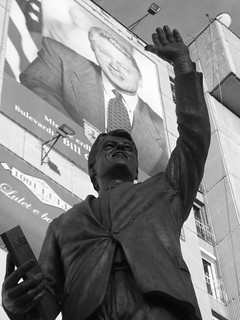

Early Life and Formative Years
William Jefferson Clinton was born on August 19, 1946, in Hope, Arkansas. His father, a traveling salesman, died in a car accident before Bill was born. Raised by his mother and grandparents, Clinton grew up in a segregated South, where his grandparents taught him the value of fairness by extending credit to customers of all races.
His childhood was marked by a difficult relationship with his stepfather, though he eventually found stability and success in his education. A talented musician, Clinton played the tenor saxophone and was a member of a jazz trio in high school. His interest in law and politics was sparked by two pivotal events in 1963: a visit to the White House to meet President John F.
Kennedy as part of the Boys Nation program, and witnessing Martin Luther King Jr.’s 'I Have a Dream' speech, which he later memorized. These experiences set him on a path toward Georgetown University, where he studied foreign service, and later Yale Law School, where he met Hillary Rodham. His time as a Rhodes Scholar at Oxford University also influenced his perspective on global affairs and the Vietnam War, a period during which he participated in protests while navigating the complexities of the military draft.
Gubernatorial Career in Arkansas
After graduating from Yale in 1973, Clinton returned to Arkansas to teach law and pursue a political career. He was elected state attorney general in 1976 and became governor of Arkansas in 1978 at the age of 32, making him the youngest governor in the country at that time. His tenure as governor was defined by a strong focus on educational reform.
Working alongside his wife, Hillary, he chaired committees that successfully overhauled the state's school system, increasing teacher salaries, implementing competency exams, and expanding vocational training. These reforms, passed during a special legislative session in 1983, are widely considered his greatest achievement as governor. Clinton also became a prominent figure in the Democratic Leadership Council, advocating for 'New Democrat' policies that emphasized welfare reform and fiscal responsibility.
This centrist approach helped him gain national recognition, eventually leading to his successful 1992 presidential campaign, where he defeated incumbent George H. W. Bush and independent Ross Perot.
The Presidency
Clinton’s presidency, spanning from 1993 to 2001, was characterized by the longest period of peacetime economic expansion in American history at the time. His administration oversaw the signing of the North American Free Trade Agreement (NAFTA) and various crime-control acts. While his attempt at national health care reform did not pass, he successfully championed the State Children's Health Insurance Program.
In the mid-1990s, following political shifts in Congress, Clinton adopted more conservative domestic policies, including the Personal Responsibility and Work Opportunity Act, while maintaining liberal social goals. A major highlight of his second term was the achievement of a federal budget surplus, the first since 1969. However, his presidency also faced significant challenges, including a highly publicized scandal involving Monica Lewinsky.
This led to his impeachment by the House of Representatives in 1998 on charges of perjury and obstruction of justice. In early 1999, the Senate acquitted him of both charges, allowing him to finish his term. Throughout his presidency, he appointed Justices Ruth Bader Ginsburg and Stephen Breyer to the Supreme Court.
Foreign Policy and Global Engagement
Clinton’s foreign policy was marked by active U.S. involvement in international conflicts and peace processes. He ordered military interventions in the Bosnian and Kosovo wars, which culminated in the Dayton Peace agreement. He also advocated for the expansion of NATO into Eastern Europe, incorporating several former Warsaw Pact members.
In the Middle East, Clinton was deeply involved in the Israeli-Palestinian peace process, participating in the Oslo I Accord and the Camp David Summit. He also worked to assist the peace process in Northern Ireland. His administration’s approach to the Middle East included the Iraq Liberation Act, which provided support to groups opposing Saddam Hussein.
These efforts reflected his belief in the importance of American leadership in maintaining global stability and resolving long-standing regional disputes through diplomacy and, when necessary, military intervention.
Post-Presidency and Humanitarian Work
Since leaving office in 2001, Clinton has remained a prominent public figure, focusing his energy on humanitarian and global issues. He established the Clinton Foundation, which has addressed critical challenges such as the prevention of HIV/AIDS, global warming, and economic development in underserved communities. His work has taken him across the globe, including serving as a United Nations special envoy to Haiti in 2009.
Following the devastating 2010 earthquake in Haiti, he partnered with former President George W. Bush to lead the Clinton Bush Haiti Fund. He has also remained active in Democratic Party politics, campaigning for his wife’s presidential bids in 2008 and 2016.
As of October 2026, he is the earliest-serving living former U.S. president and the last surviving president to have served in the 20th century. His post-presidential career is viewed as a continuation of his commitment to public service, utilizing his experience and influence to address complex international problems and support various charitable causes.
See also
Based on content from Wikipedia · Licensed under CC BY-SA 4.0